
← Back to Articles
Bitcoin Basics
What Is the Lightning Network? Bitcoin Payments Explained
Thu Apr 30 2026 • 8 min read
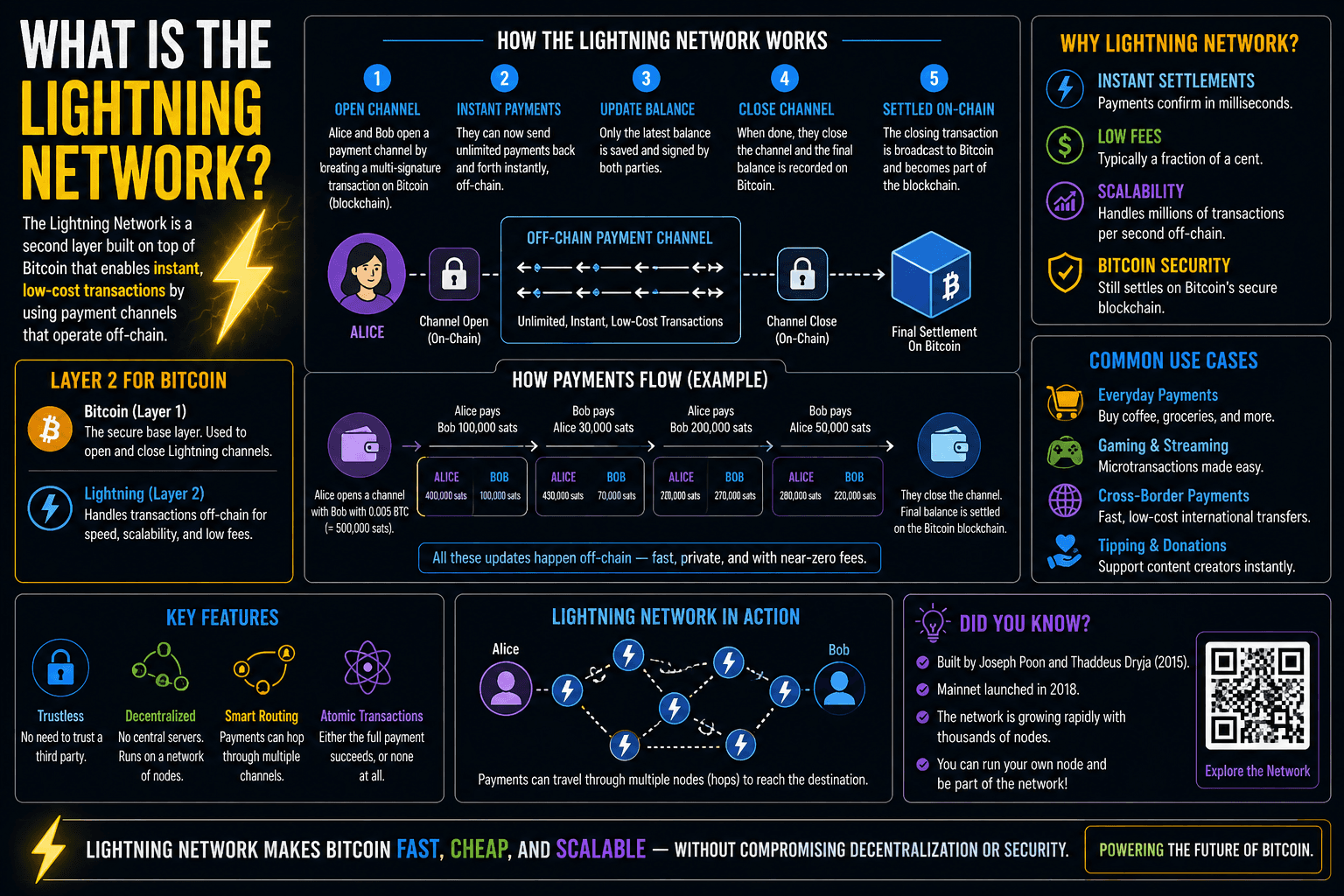
The Lightning Network is a second-layer system built on top of Bitcoin that allows for fast, low-cost payments.
Instead of recording every transaction on the blockchain, Lightning moves smaller payments off-chain while still relying on Bitcoin for security.
---
## How the Lightning Network works
Lightning uses payment channels between users.
A channel is created by locking bitcoin into a multi-signature address on the blockchain.
Once opened, users can send transactions back and forth instantly without waiting for block confirmations.
Only when the channel is closed is the final balance recorded on the Bitcoin blockchain.
---
## Why Lightning exists
Bitcoin’s base layer is designed for security and decentralization, not speed.
Blocks are limited in size and arrive roughly every 10 minutes.
This means:
- Transactions can take time to confirm
- Fees can increase during congestion
Lightning solves this by handling small, frequent payments off-chain.
---
## Instant and low-cost payments
Lightning transactions are:
- Nearly instant
- Extremely low fee
- Scalable for millions of users
This makes it ideal for:
- Everyday payments
- Micropayments
- Streaming payments
- Tipping
---
## Routing payments
You don’t need a direct channel with every person you pay.
Lightning uses a network of nodes to route payments across multiple channels.
This works similarly to how data moves across the internet.
---
## Security and trust
Lightning is designed to be trust-minimized.
Users still control their funds through cryptographic keys.
If one party tries to cheat, the protocol allows the other to claim the full balance as a penalty.
---
## Tradeoffs and limitations
Lightning is powerful, but it comes with tradeoffs:
- Requires liquidity in channels
- Can be more complex than on-chain transactions
- Large payments may be harder to route
- Requires online presence for best security
---
## Lightning vs on-chain Bitcoin
On-chain Bitcoin:
- Slower
- Higher fees during congestion
- Maximum security
- Best for large transfers
Lightning Network:
- Instant
- Low fees
- Best for small, frequent payments
---
## Real-world use cases
Lightning is already being used for:
- Paying for goods and services
- Sending money across borders
- Streaming payments per second
- Content tipping
- Gaming and apps
---
## Internal connections
The Lightning Network builds on core Bitcoin concepts:
- Transactions are still ultimately settled on-chain
- Fees are influenced by network demand
- Nodes play a role in routing payments
---
## Key takeaway
The Lightning Network makes Bitcoin usable for everyday payments.
It allows users to send fast, cheap transactions while still relying on Bitcoin’s base layer for final settlement and security.
Related Articles
Bitcoin Basics
What Is Bitcoin?
A clear, practical explanation of what bitcoin is, how it works, and why it matters.
Bitcoin Basics
How to Buy Bitcoin Safely
A practical guide to buying bitcoin while avoiding scams and unnecessary risk.
Bitcoin Basics
What Is a Bitcoin Block?
Learn how transactions are grouped into blocks and added to the Bitcoin blockchain.